TPU Filament: A Guide to Printing Flexible Seals & Gaskets
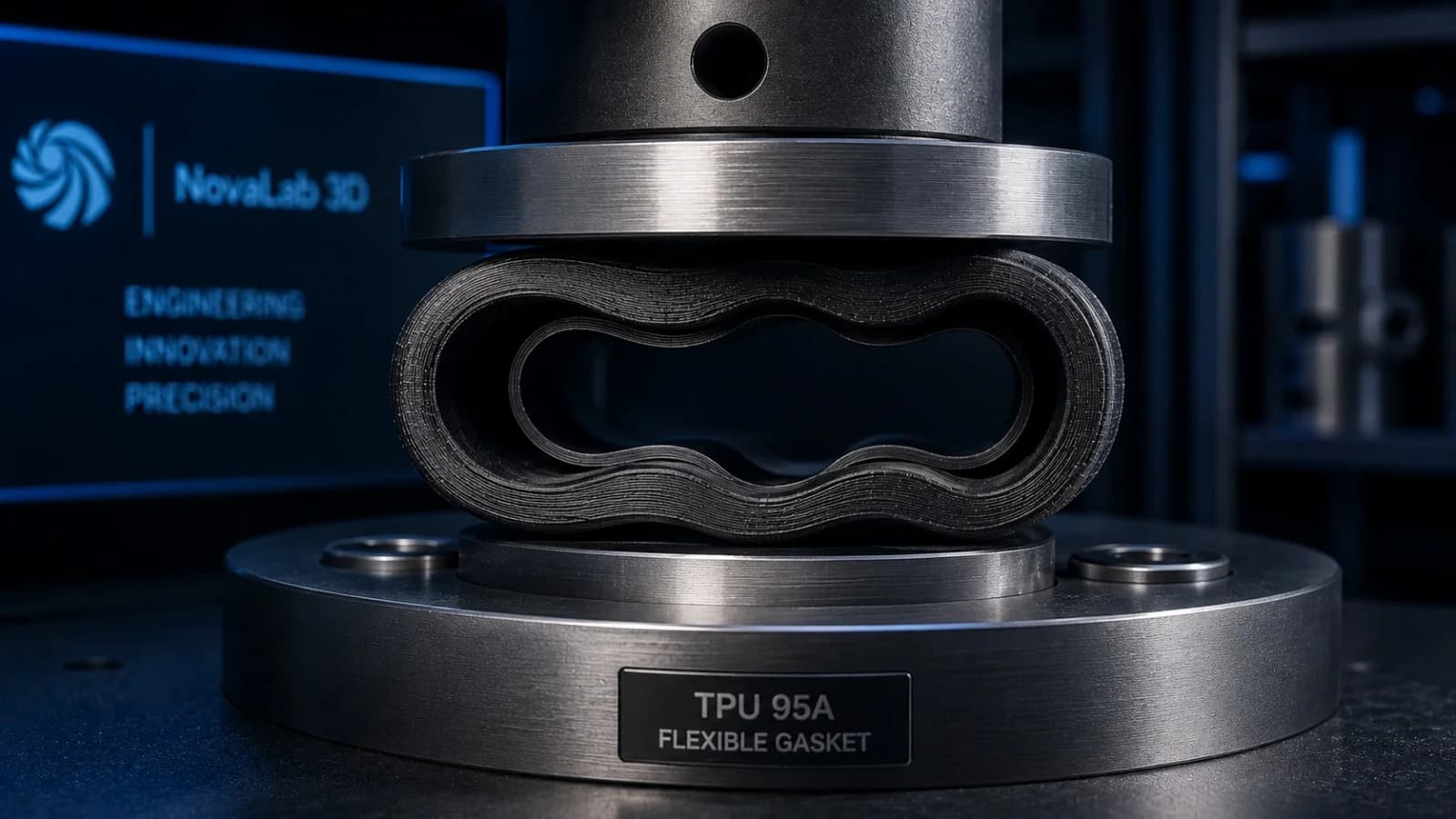
TPU is an elastic polymer with high abrasion and tear resistance, making it the premier choice for seals, custom gaskets, dampers, and impact-absorbing bumpers.
Rubber-Like Additive Manufacturing
FDM 3D printing is often associated with rigid plastic parts. However, by using Thermoplastic Polyurethane (TPU), we can fabricate parts with rubber-like elasticity, excellent vibration damping, and high abrasion resistance.
TPU is widely used in automotive, consumer product, and industrial settings to produce gaskets, flexible seals, dust bellows, vibration dampeners, and ergonomic grips.
TPU combines elastomer flexibility with thermoplastic durability, allowing for the rapid prototyping of functional gaskets and custom vibration dampers without expensive tooling.
Shore Hardness: Sizing up the Flex
TPU is available in various grades of hardness, measured using the Shore scale. The two most common printing grades are:
- Shore 95A: Similar in flexibility to a shopping trolley wheel or shoe heel. It is relatively easy to print and offers excellent impact resistance and structural flex.
- Shore 85A: Significantly softer, similar to a rubber band or soft gasket. It is highly flexible but requires specialised direct-drive extruders to print reliably.
Design Guidelines for Flexible Parts
Designing for TPU requires a shift in mindset compared to rigid polymers:
- Wall Thickness and Infill: You can control the stiffness of a TPU part by adjusting its shell thickness and infill density. A part printed with 2 perimeters and 10% infill will be soft and squishy, while the same part printed with 6 perimeters and 50% infill will behave like a stiff rubber block.
- Avoid Support Material: Support material is extremely difficult to remove from TPU because the flexible structures bend and weld together. Always design TPU parts to be self-supporting, avoiding steep overhangs.
- Clearance Fits: Flexible parts can stretch and compress. For slip-on grips or seals, design the inner dimensions slightly smaller (0.5% to 1% interference fit) than the mating part to ensure a tight, secure fit.
Elastomeric Prototypes in Yorkshire
Need a custom seal or impact damper? NovaLab 3D specialises in printing high-durability TPU parts at our Pickering facility. Upload your geometry today for a tailored material and design review.
Frequently Asked Questions
Keagan Walker
Founder & Lead Designer
NovaLab 3D is a boutique engineering and additive manufacturing studio based in Pickering, North Yorkshire. We provide B2B clients and product developers with direct access to lead engineering consulting, fast 48-hour turnarounds, and custom FDM production runs.