PETG vs PLA: The Battle of Utility Filaments
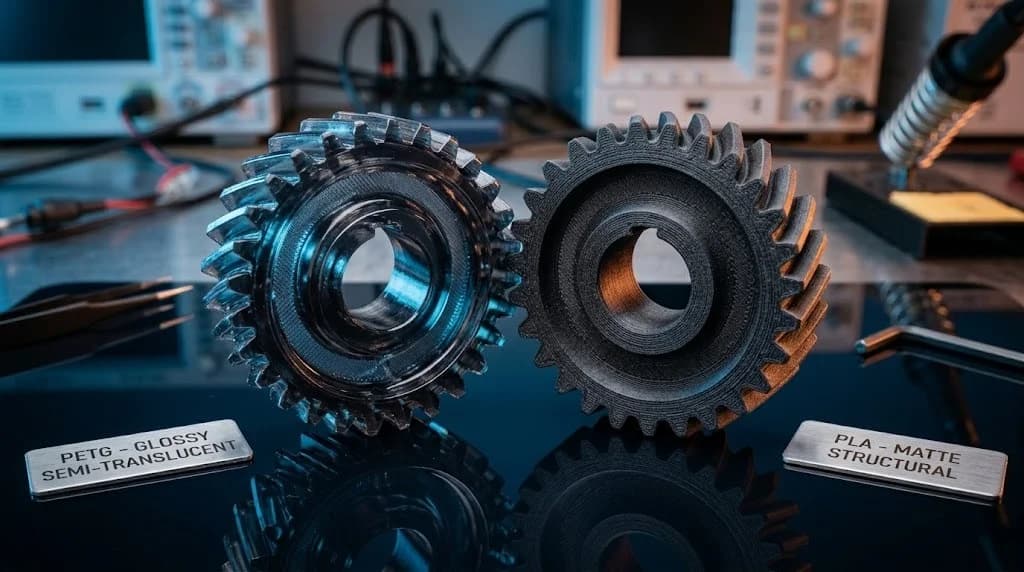
PLA offers unmatched detail and stiffness for visual models and fits, while PETG provides impact resistance, chemical durability, and UV stability for functional components.
Selecting the Right Baseline Polymer
When starting an additive manufacturing project, the first decision is choosing the right material. PLA (Polylactic Acid) and PETG (Polyethylene Terephthalate Glycol) are the two most widely used filaments in the industry. While they may look similar on the build plate, their mechanical, chemical, and thermal properties are very different.
Understanding these differences is key to ensuring your prototypes or production parts perform as expected under real-world conditions.
Choose PLA for cosmetic models, visual prototypes, and high-detail items. Choose PETG for functional components, outdoor fixtures, and parts requiring impact resistance.
PLA: Precision and Aesthetics
PLA is a biodegradable thermoplastic derived from renewable resources like corn starch. It is renowned for its ease of printing and cosmetic quality:
- Dimensional Accuracy: Negligible shrinkage means parts warp very little, making it ideal for large prints and tight interlocking fits.
- Fine Detail: Captures sharp corners, overhangs, and fine text better than almost any other material.
- Rigidity: Very stiff, which is excellent for load-bearing structures that must not bend. However, this stiffness makes it brittle under sudden impact.
- Temperature Limit: Begins to soften at just 50°C to 55°C. It should not be used in cars, heated enclosures, or warm outdoor climates.
PETG: Toughness and Chemical Resistance
PETG is a glycol-modified version of PET, the plastic used in drinks bottles. It offers enhanced durability:
- High Impact Strength: PETG is less rigid than PLA but significantly tougher. It will flex slightly under load rather than snapping, absorbing energy without breaking.
- Thermal Durability: Softens at around 75°C to 80°C, making it suitable for warm environments and outdoor applications.
- Chemical Resistance: Highly resistant to acids, alkalis, and oils.
- UV Stability: Resists solar degradation much better than PLA, which will degrade and become brittle when exposed to sunlight over long periods.
Which Filament Fits Your Budget?
At NovaLab 3D, we maintain a deep inventory of both PLA and PETG in a wide variety of colours. We can guide you to the right choice during our standard CAD quoting process. Upload your files today for a quick review.
Frequently Asked Questions
Keagan Walker
Founder & Lead Designer
NovaLab 3D is a boutique engineering and additive manufacturing studio based in Pickering, North Yorkshire. We provide B2B clients and product developers with direct access to lead engineering consulting, fast 48-hour turnarounds, and custom FDM production runs.