How North West Manufacturers Are Bridging the Gap to Production with Small-Batch 3D Printing
Tooling delays and supply chain disruptions can halt product launches and damage client relationships. Small-batch 3D printing provides an agile solution, allowing manufacturers in Lancashire and Greater Manchester to produce production-grade components without high up-front tooling costs. By utilizing industrial polymers and composites, companies can bridge the gap from prototype to mass production, fulfill early orders, and ramp up supply chains with zero downtime.
The Production Gap Challenge
Every manufacturer faces a common challenge during product launches. Your product has been designed, prototype models have been tested, and the design is fully validated. The production-grade injection mould has been ordered, but the toolmaker indicates a lead time of twelve to sixteen weeks. Meanwhile, your sales team has secured initial orders, and your clients expect deliveries next month.
This delay represents the production bridge gap. In conventional manufacturing, this period is often a source of significant friction. Delaying product delivery can damage client relationships, allow competitors to capture market share, and freeze early-stage revenue. Sourcing quick metal tooling is extremely expensive and often impossible on short notice.
Small-batch 3D printing provides a modern, tool-free solution to this problem. By using FDM (Fused Deposition Modelling) with industrial-grade polymers, North West manufacturers can produce batch sizes of fifty to five hundred units within days, maintaining product launches while conventional tools are completed.
1. Slicing Through the Economics of Short Runs
To understand why small-batch 3D printing makes financial sense, we have to look at the differences in cost structures between additive and subtractive manufacturing.
Injection Moulding
This method has a very high initial setup cost because of tooling. Cutting a steel or aluminum mould can cost anywhere from £3,000 to £20,000. Once the tool is cut, however, the cost per part is extremely low. This makes it ideal for high-volume runs but highly inefficient for small volumes.
Additive Manufacturing
FDM 3D printing requires zero tooling. You pay only for the machine runtime and the raw material. This means the up-front cost is near zero, and the cost per part remains flat.
For short production runs of under five hundred units, 3D printing is almost always more cost-effective. It avoids the capital risk of tooling, allows for late-stage design modifications without financial penalty, and enables immediate production.
2. Industrial Materials for Shop-Floor Deployment
For small-batch components, visual aesthetics are not enough. The printed parts must withstand real-world operational stress. We stock high-performance polymers suited for industrial applications:
ASA (Acrylonitrile Styrene Acrylate)
ASA is the primary material for outdoor enclosures, automotive mounting brackets, and agricultural guides. It offers high impact resistance and outstanding UV stability, ensuring parts do not yellow or become brittle in outdoor environments.
PETG (Polyethylene Terephthalate Glycol)
PETG is highly resistant to chemicals, acids, and bases. It is commonly used for manufacturing liquid guides, protective guards, and custom containers.
PA6-CF (Carbon Fibre Reinforced Nylon)
When ultimate structural stiffness is required, carbon fibre composites deliver excellent results. We use PA6-CF for high-load mounting clips, robotic end-effectors, and alignment tooling.
3. Maintaining Production Quality Control
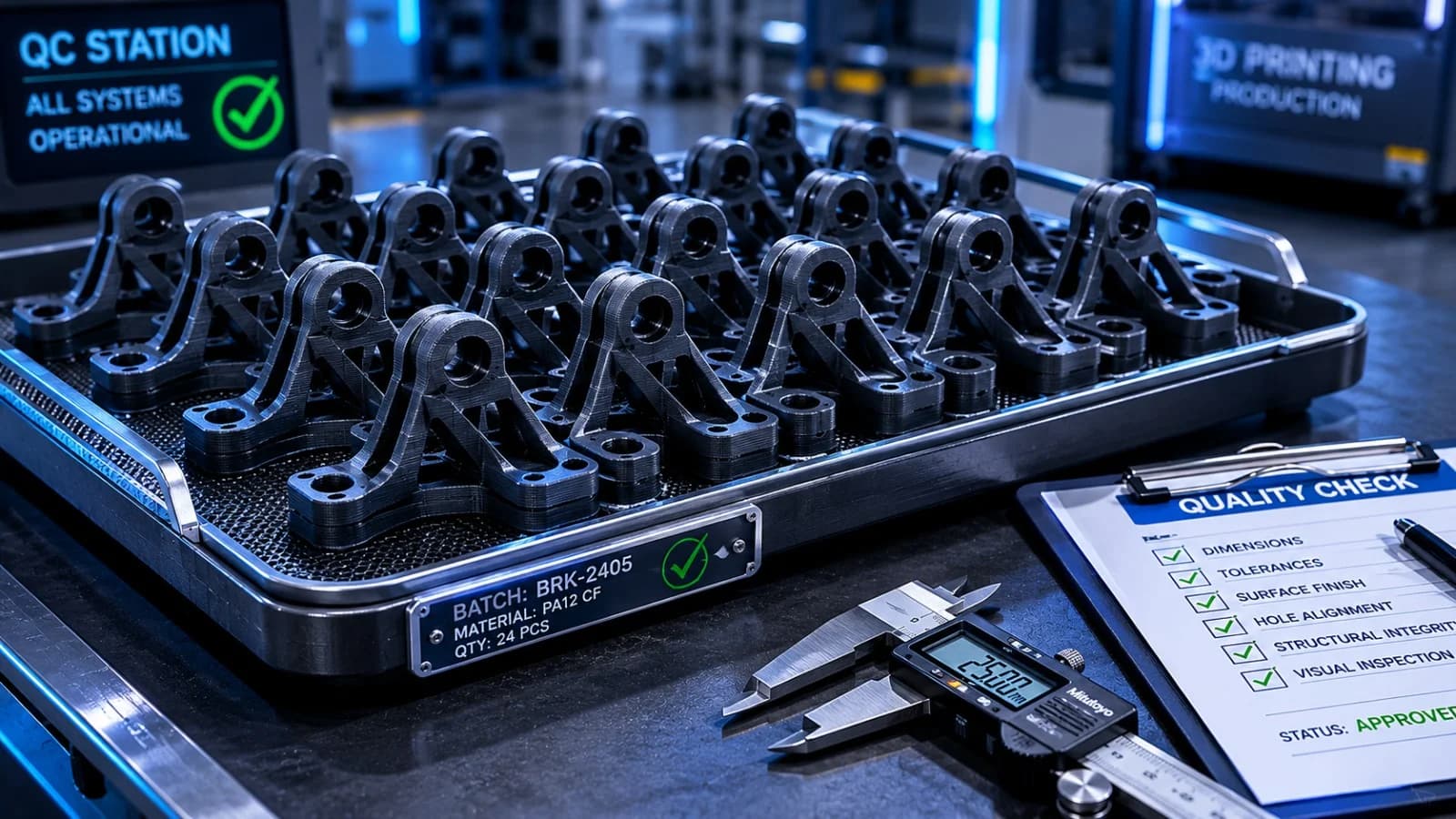
Transitioning from prototyping to production printing requires strict quality management. At NovaLab 3D, we ensure consistency across every batch using a systematic process: * Fixed Slicer Profiles: We use locked machine configurations for every production run to ensure layers fuse identically on every part. * First-Article Inspection: We print and measure test parts before commencing the full run to verify dimensional tolerances. * Post-Assembly and Threading: We press-fit brass threaded inserts and assemble hardware in-house, delivering completed, ready-to-install assemblies directly to your production line.
By partnering with a northern bureau, manufacturers in Lancashire, Greater Manchester, and Merseyside can secure rapid, reliable production bridging that keeps supply chains moving.
Frequently Asked Questions
Keagan Walker
Founder & Lead Designer
NovaLab 3D is a boutique engineering and additive manufacturing studio based in Pickering, North Yorkshire. We provide B2B clients and product developers with direct access to lead engineering consulting, fast 48-hour turnarounds, and custom FDM production runs.