How Carbon Fibre FDM Filaments Solve Robot End-Effector Weight Limits
Manufacturing robotic end-effectors in carbon-fibre FDM composites reduces arm payload weight, increases operational speeds, and cuts tooling costs compared to machined aluminum.
Lightweighting the Robotics Factory Floor
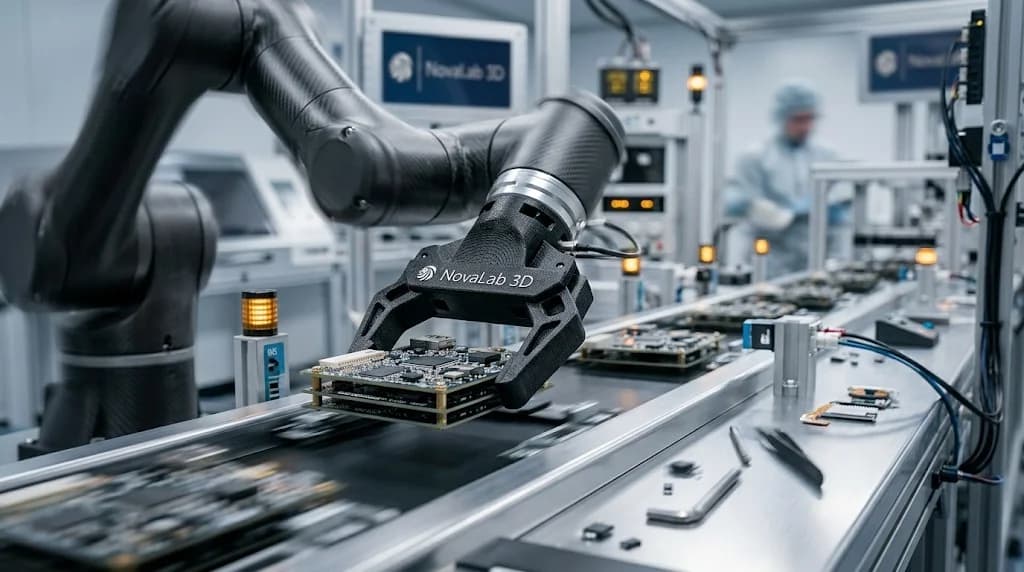
In industrial automation, payload capacity is a precious resource. A robotic arm has a strict weight limit (e.g. 5kg or 10kg) that it can lift. Every gram of weight in the end-effector (the gripper, vacuum array, or tool at the end of the arm) is payload capacity taken away from the product the robot is handling.
Traditional steel or aluminium end-effectors are heavy. By redesigning these assemblies for additive manufacturing in Carbon Fibre Reinforced composites, robotics integrators can reduce end-of-arm tool weight by up to 60%.
Carbon Fibre FDM filaments allow you to fabricate stiff, lightweight robot grippers, increasing robot payload capacity and allowing for faster cycle speeds.
Why Stiffness Matters in Robotics
In automation, vibration is the enemy. A flexible gripper will wobble when the robotic arm accelerates or decelerates, forcing the integrator to slow down the robot's cycle times to allow the vibration to settle.
Carbon Fibre reinforced filaments (like Carbon-PETG or Carbon-Nylon) solve this:
- High Flexural Modulus: The carbon micro-strands suspended in the polymer resist bending forces, resulting in structural rigidity approaching aluminium.
- Low Inertia: Reducing the mass of the tool reduces the inertia of the arm. The robot can accelerate, decelerate, and change direction faster without overloading its motors or triggering safety stops.
- Complex Duct Geometry: Robotic end-effectors often require vacuum lines or pneumatic hoses. Additive manufacturing allows us to print the vacuum channels directly inside the structural walls of the gripper, eliminating external hoses that could snag.
Robotics Integration Support
At NovaLab 3D, we work with robotics developers across Northern England to lightweight end-of-arm tooling. Contact Keagan Walker in Pickering to discuss custom carbon composite components for your automation line.
Frequently Asked Questions
Keagan Walker
Founder & Lead Designer
NovaLab 3D is a boutique engineering and additive manufacturing studio based in Pickering, North Yorkshire. We provide B2B clients and product developers with direct access to lead engineering consulting, fast 48-hour turnarounds, and custom FDM production runs.